
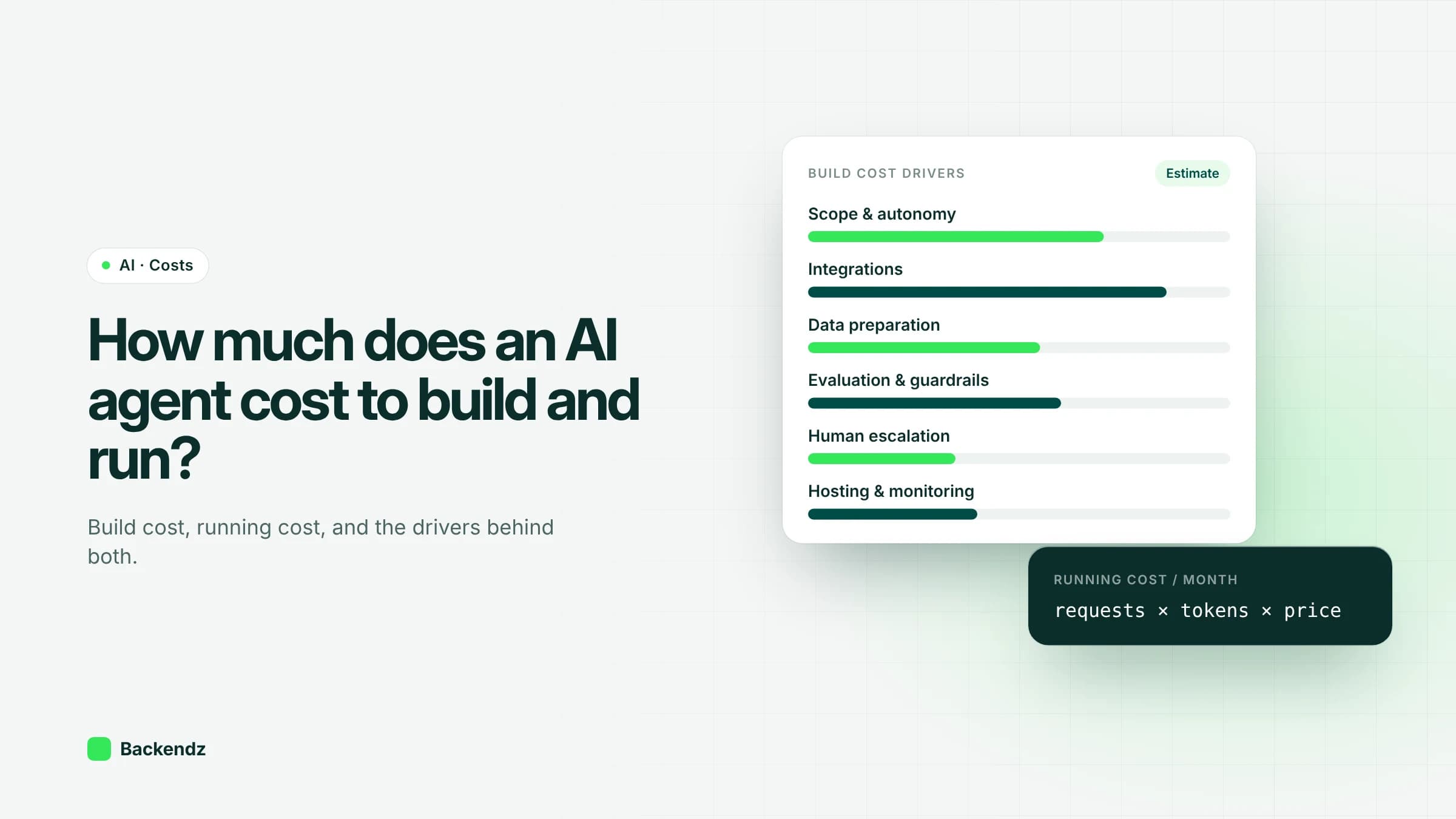
AI agent development cost in the UK is driven mainly by how much the agent is allowed to do on its own, how many systems it connects to, and how much testing it needs. Published UK market ranges run from about £10,000 for a single-workflow agent to £200,000 or more for multi-agent systems, plus monthly running costs.
Those numbers are wide because "AI agent" covers everything from a bot that drafts replies for a person to approve, to a system that reads invoices, queries your ERP and posts journals unattended. This guide breaks the cost into its parts, separates what you pay once from what you pay every month, and shows how to estimate model usage yourself before anyone quotes you.
How much does an AI agent cost in the UK?
There is no single price, but there are published market ranges you can use as a sense check. Treat them as market ranges from other providers, not Backendz quotes.
LeverX's UK cost guide gives indicative benchmarks of £10K–£30K for a single-workflow agent (5–9 weeks), £30K–£80K for a multi-step agent (10–18 weeks) and £80K–£200K+ for enterprise multi-agent systems (5–9 months).
Cloudswitched's 2026 UK AI development cost guide splits custom agents into four tiers: reactive (£15,000–£40,000), task (£35,000–£80,000), reasoning (£70,000–£150,000) and orchestrator agents (£120,000–£300,000+). The same guide lists monthly running items separately, including infrastructure and compute at £500–£5,000 a month and support and maintenance at £1,000–£5,000 a month.
The two sources broadly agree on shape. A narrow agent with one or two integrations is a five-figure project. Anything that coordinates several agents or acts across many systems quickly becomes six figures. Where your project lands depends on the drivers below, not on the word "agent".
What actually drives the cost to build an AI agent?
Most of the budget goes on the engineering around the model, not the model itself. Calling an LLM is cheap to set up. Making it reliable inside your business is where the time goes.
Scope and autonomy
The single biggest factor is what the agent may do without a person checking. An agent that drafts a reply for a human to send needs modest testing. An agent that issues credit notes or changes stock levels needs permission controls, approval steps, audit logs and far more test cases, because a mistake costs real money.
Number of systems and integrations
Each system the agent reads from or writes to adds work: authentication, error handling, rate limits, test environments and data mapping. A clean modern API is a few days. An on-premises database or an ERP with custom fields can take weeks. Cloudswitched's guide prices a single modern API integration at £2,000–£5,000 and a legacy or on-premises system at £15,000–£40,000 per system, which shows how much the type of system matters.
Data preparation
Agents that answer from your documents or records need that data findable and current. That can mean cleaning product catalogues, deduplicating supplier records, chunking policy documents for retrieval, or building a small labelled set of real examples. If you are weighing retrieval against training a model on your data, our explainer on RAG versus fine-tuning covers the trade-off. Poor data is the line item most often underestimated.
Evaluation and guardrails
You need a test set of real cases with known correct outcomes, run every time the prompt, model or tools change. You also need guardrails: input validation, output checks, limits on what each tool can do and defences against prompt injection. This is unglamorous work, and it is what separates an agent you can leave running from one you have to watch. We cover it in depth in what separates an agent that ships from one that demos.
Human escalation
Every production agent needs a route for cases it should not handle: low confidence, unusual values, angry customers, anything above a money threshold. Building that queue, the screen a person uses to review cases and the feedback loop back into testing is real scope.
Hosting, monitoring and security
Logging, tracing, dashboards, alerting, secrets management and access control all need building or configuring. If your data must stay in the UK or in your own cloud tenancy, that constrains model and hosting choices and can add cost.
What are the different types of AI agent, and what drives the cost of each?
The table below groups agents by autonomy. The cost ranges are LeverX's published market benchmarks, used here for orientation only.
| Agent type | What it typically does | Main build cost drivers | Main running cost drivers | Market range (LeverX) |
|---|---|---|---|---|
| Simple single-task assistant | One job, such as classifying inbound emails or drafting a reply for a person to approve | Prompt design, one or two integrations, a small evaluation set | Low token volume, light monitoring | £10K–£30K |
| Multi-step workflow agent | Several steps across systems, such as reading an invoice, matching it to a PO and goods receipt, then flagging exceptions | Several integrations, tool permissions, escalation queue, larger regression set, audit logging | Multiple model calls per task, retrieval, review time for exceptions | £30K–£80K |
| Multi-agent or high-autonomy system | Agents that plan, delegate to other agents and take actions with limited oversight | Orchestration, strict guardrails, extensive evaluation, staged rollout, security review | High token use per task, tracing across agents, ongoing tuning and support | £80K–£200K+ |
What does an AI agent cost to run each month?
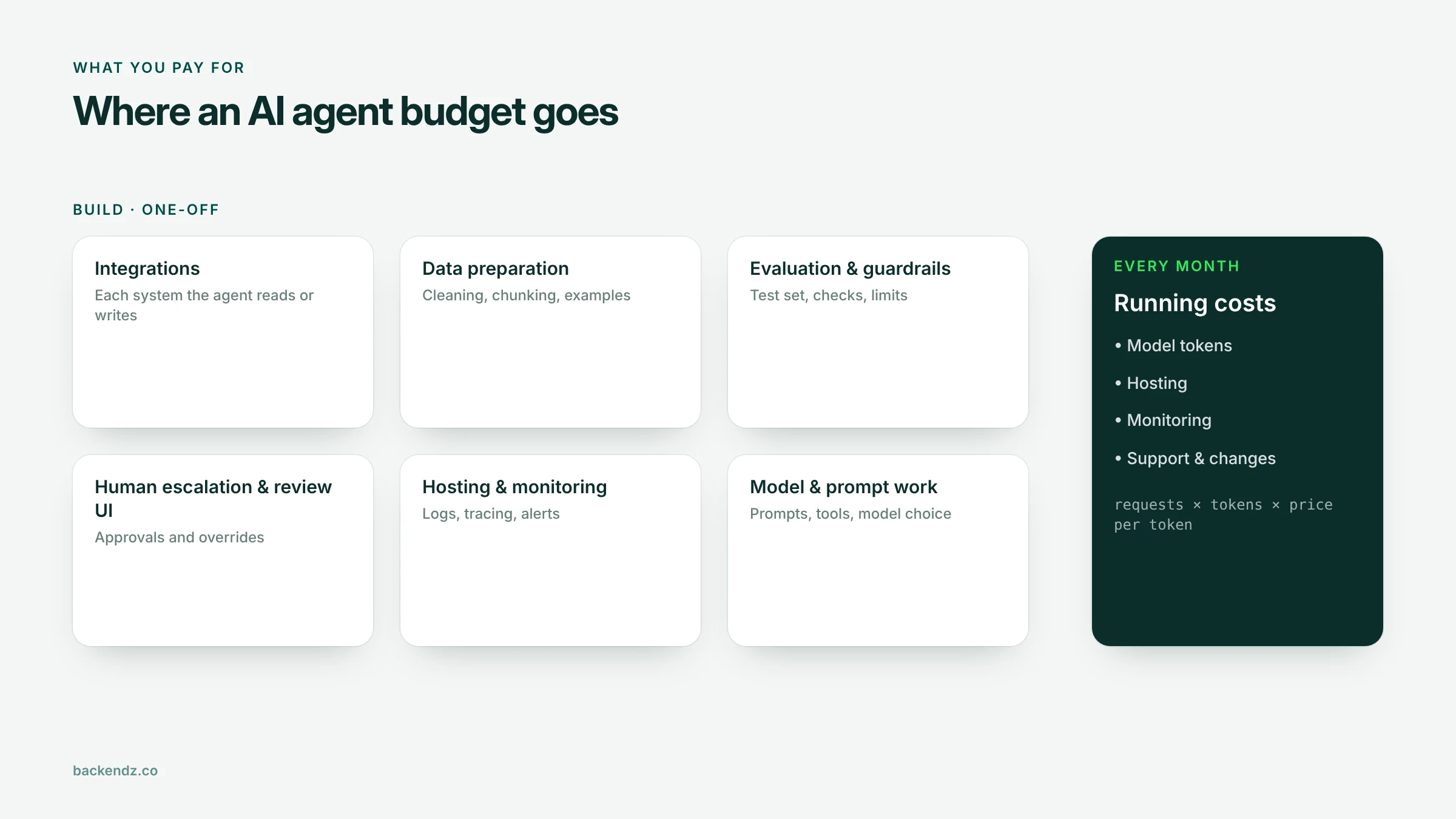
Build cost is paid once. Running cost is paid for as long as the agent is live, and it is easy to forget when comparing quotes. It usually has five parts:
- Model usage: tokens sent to and returned from the LLM.
- Hosting: compute, databases, vector stores and queues.
- Monitoring and evaluation: tracing tools, scheduled regression runs and someone reviewing the results.
- Human review time: the people who handle escalated cases. This is a real cost even though it replaces more manual work.
- Maintenance: prompt updates, model version changes, integration fixes when another system's API changes.
For many business agents, model usage is a smaller share than people expect. Hosting, monitoring and the person-hours spent on support and review often cost more.
How do you estimate AI agent running costs?
You can estimate token spend before any build starts with one formula:
Monthly model cost = requests per month × tokens per request × price per token
Do it separately for input tokens (what you send) and output tokens (what the model writes), because output is usually priced several times higher. Model providers publish prices per million tokens, for example on this public model pricing page. Prices are listed in US dollars and change often, so check the current figures.
A worked example (illustrative numbers)
Take an agent that triages supplier queries. All figures below are illustrative, chosen to show the method.
- 500 queries per working day, 22 working days: 11,000 tasks a month
- Each task makes 4 model calls (classify, retrieve and read the account, draft, check)
- Each call sends about 3,000 input tokens and returns about 400 output tokens
- A mid-tier model priced at $2 per million input tokens and $10 per million output tokens
Input: 11,000 × 4 × 3,000 = 132 million tokens × $2 per million = $264
Output: 11,000 × 4 × 400 = 17.6 million tokens × $10 per million = $176
Estimated model cost: about $440 a month.
Now change two assumptions. If the agent makes 10 calls per task and stuffs 8,000 tokens of retrieved context into each, input becomes 880 million tokens ($1,760) and output at 500 tokens per call becomes 55 million ($550). That is about $2,310 a month for the same workload, roughly five times more.
The lesson is that design choices drive running cost far more than the headline price. The number of calls per task, how much context you send and which model handles which step all matter. Cheaper ways to cut the bill include using a smaller model for simple steps such as classification, caching repeated instructions (the same pricing page lists discounted cache reads) and sending non-urgent work through batch processing, which that provider prices at a 50% discount.
Why start with a proof of concept?
Most of the uncertainty in an agent budget comes from questions you cannot answer on paper. Is the data good enough? What accuracy can you reach on real cases? How many calls does a task need? A short, scoped AI proof of concept answers those with your own data before you commit to a full build.
This matters because cost overruns are a known failure mode. Gartner predicts that over 40% of agentic AI projects will be cancelled by the end of 2027, citing escalating costs, unclear business value or inadequate risk controls. A PoC with a measured baseline and agreed success criteria addresses all three. Our guide to running an AI proof of concept sets out how to structure one so it ends in a clear decision.
When not to build an agent at all: if the process is fully rule-based with clean inputs, ordinary automation is cheaper and more predictable. If volumes are tiny, a person may simply be faster. Agents earn their cost where inputs are messy and judgement is needed at volume.
Frequently asked questions
How much does an AI agent cost in the UK?
Published UK market ranges put a single-workflow agent at roughly £10,000–£30,000 and a multi-step agent at £30,000–£80,000, with enterprise multi-agent systems at £80,000–£200,000 or more (LeverX). These are market benchmarks rather than quotes. Your figure depends on autonomy, the number of integrations, data quality and how much testing the agent needs.
What are the ongoing costs of an AI agent?
Ongoing costs cover model usage (tokens), hosting, monitoring and evaluation, human review of escalated cases and maintenance. One UK guide lists infrastructure at £500–£5,000 a month and support at £1,000–£5,000 a month. Model usage can be estimated in advance from expected volumes and the provider's published token prices.
How do I estimate token costs for an AI agent?
Multiply requests per month by tokens per request by the price per token, and do it separately for input and output tokens. Count every model call in a task, not just one, and include any retrieved documents in the input. Small design changes, such as more calls per task, can multiply the result several times.
Is it cheaper to buy an off-the-shelf agent than build one?
For common, standalone tasks, a hosted product is often cheaper to start with. Custom builds make sense when the agent has to work across your own systems, follow your business rules or keep data inside your environment. Compare total cost over two or three years, including per-seat or per-conversation fees, not just the first invoice.
Why do AI agent projects go over budget?
The usual causes are underestimated integration work, poor data and missing evaluation, which leads to repeated rework once real cases arrive. Running costs also grow when designs make many model calls per task. Starting with a timeboxed proof of concept on real data exposes these issues while they are still cheap to fix.
Talk it through with us
If you have a process in mind and want a realistic view of build and running costs before committing, we can help you scope it, starting small and with your own data. See how we approach AI agent development.